Contents
From Automation to Understanding: The Next Phase of AI Video Editing
Trend #1: AI Will Understand Context, Emotion, and Narrative
Trend #2: Searchable Video Intelligence Will Replace Manual Asset Management
Trend #3: Long-Form Video Understanding Will Improve Content Discovery
Trend #4: AI Will Learn What Makes a Clip Worth Watching
Trend #5: One Recording Will Become an Entire Content System
Trend #6: Personalized Video Creation Will Scale Automatically
Trend #7: Multimodal AI Will Blur the Line Between Editing and Generation
What These Trends Mean for Content Creators
Where Vmaker AI Fits Into the Future of AI Video Editing
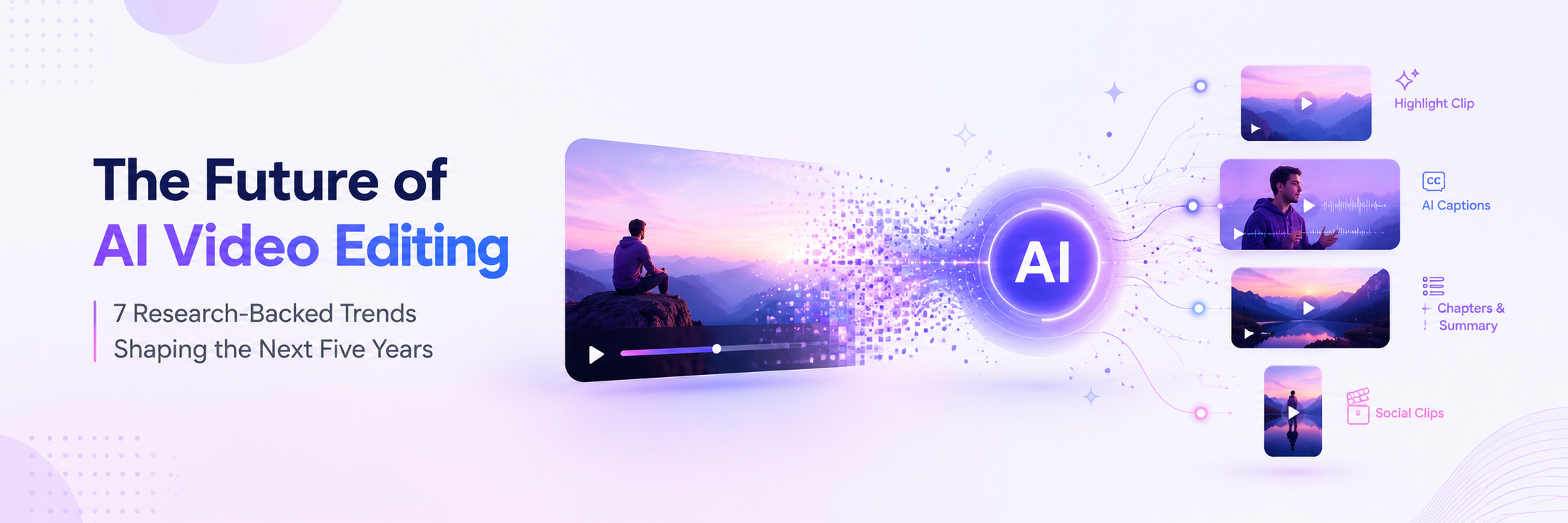
The Future of AI Video Editing: 7 Research-Backed Trends Shaping the Next Five Years
Video has become the dominant format for communication, marketing, education, and audience engagement.
According to Wyzowl's Video Marketing Statistics report, 91% of businesses now use video as a marketing tool, while 82% of marketers report positive ROI from video marketing efforts. Meanwhile, Sprout Social reports that 85% of consumers say video has helped them make a buying decision, highlighting the growing influence of video content throughout the customer journey.
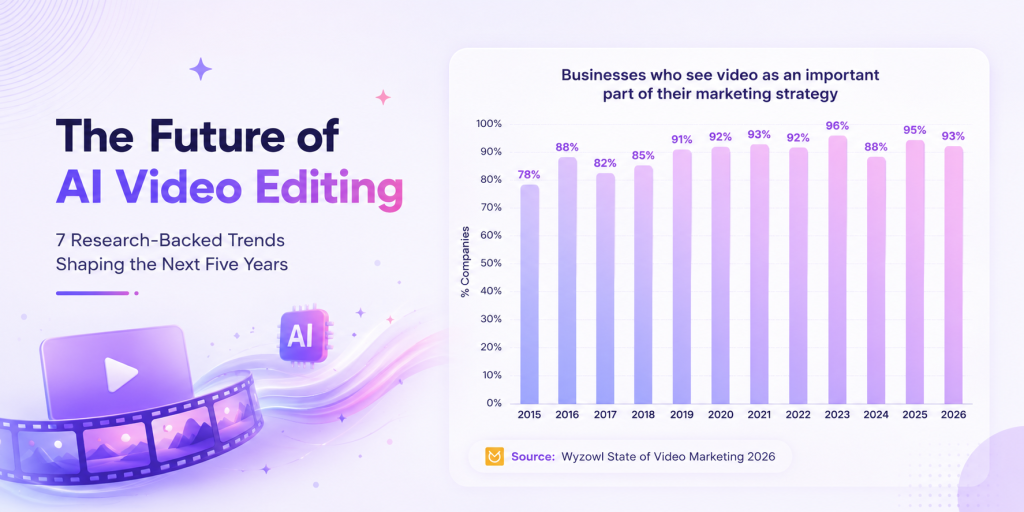
This growth is reflected not only in industry-wide adoption but also in content production itself. Internal analysis of video processing activity across the Vmaker AI ecosystem shows a steady increase in the volume of video content being created by our AI Video Editor over the past few years, highlighting the growing reliance on video across business, creator, and marketing workflows.
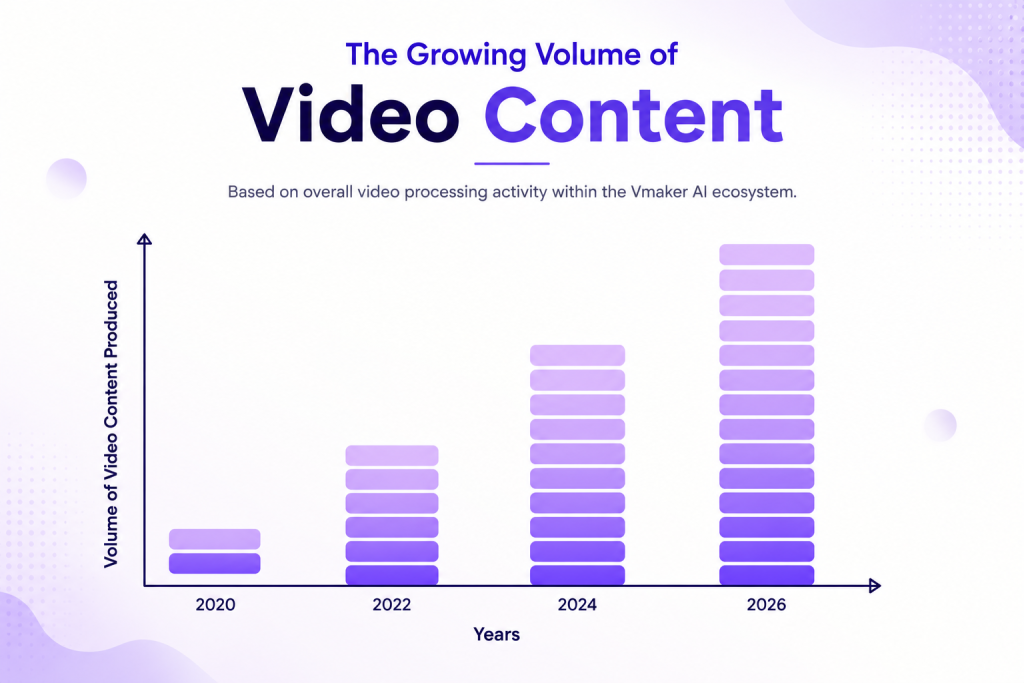
As the volume of video content continues to grow, editing and repurposing that content at scale has become a major challenge for creators and businesses. AI-powered tools have already streamlined tasks such as captioning, clipping, silence removal, and formatting, helping teams produce more content in less time.
However, the future of AI video editing extends far beyond automation. Advances in Video LLMs, multimodal AI, and long-video understanding are enabling systems that can analyze context, identify meaningful moments, understand narratives, and assist with creative decision-making.
In this article, we'll examine seven research-backed trends that are shaping the next generation of AI video editing.
From Automation to Understanding: The Next Phase of AI Video Editing
The first generation of AI video editing focused on automating repetitive tasks such as captioning, silence removal, scene detection, and video clipping. These capabilities significantly reduced manual editing effort, but they did not fundamentally change how editing decisions were made.
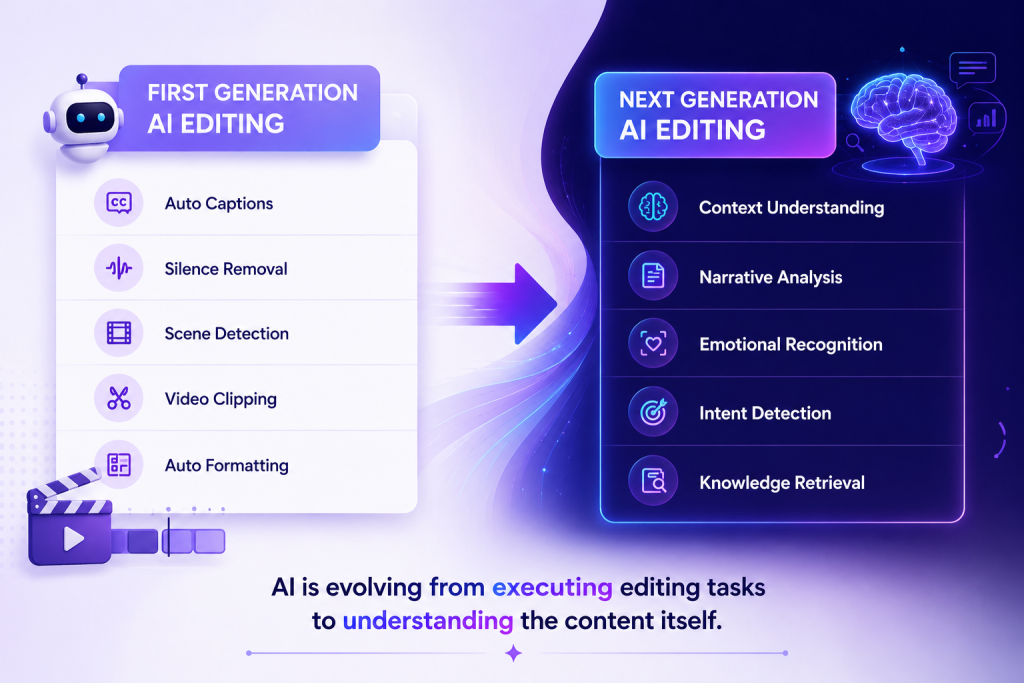
Today, researchers are pursuing a more ambitious goal: enabling AI systems to understand video content rather than simply process it.
Advances in Video Large Language Models (Video LLMs), multimodal AI, and long-video understanding are allowing systems to analyze speech, visuals, actions, and context simultaneously. This shift is moving AI beyond workflow automation and toward content intelligence.
The next generation of AI video editing will not simply help creators edit faster. It will help them discover insights, identify narratives, retrieve knowledge, and generate content automatically.
This evolution provides the foundation for the seven trends discussed below.
Trend #1: AI Will Understand Context, Emotion, and Narrative
Most AI editing systems today rely on surface-level signals.
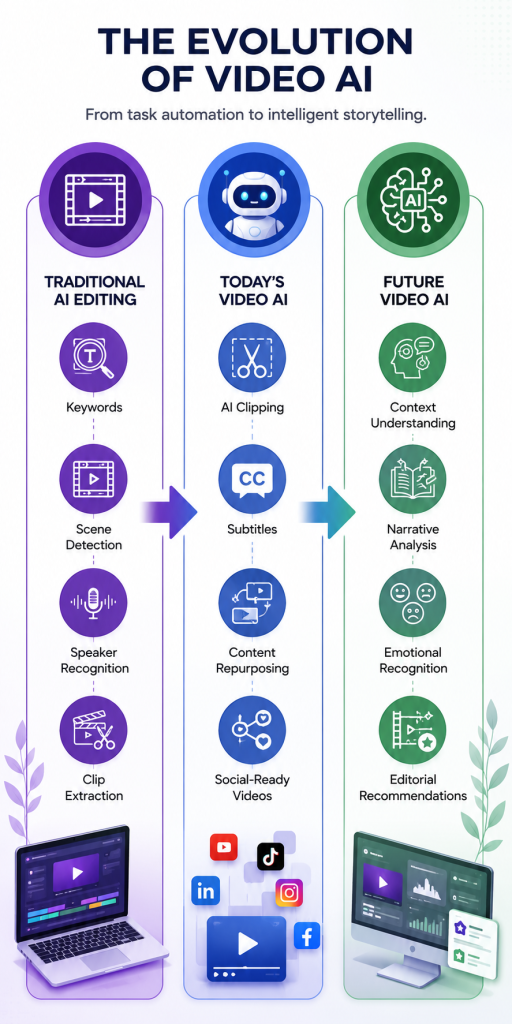
They identify keywords, detect scene changes, recognize speakers, locate pauses, and analyze engagement patterns. While useful, these methods don't fully explain why a particular moment matters.
Researchers are now developing Video LLMs capable of understanding relationships between speech, visuals, actions, and context. Projects such as Google Gemini, Video-LLaMA, and Video-ChatGPT are moving AI beyond simple editing tasks and toward deeper content understanding.
This shift is already influencing modern editing workflows. Today, tools like Vmaker AI help creators automate clipping, subtitles, and content repurposing, making it easier to turn long-form videos into shareable content. While current AI focuses primarily on automation, the next generation of video AI may be able to understand why a moment is important, not just what appears on screen.
Key Takeaways
- Traditional AI: Detects keywords, scenes, speakers, and pauses.
- Emerging Research: Focuses on understanding context, narratives, and relationships across a video.
- Vmaker AI Today: Helps creators extract highlights, generate clips, add subtitles, and repurpose content faster.
- Future AI: May identify emotional moments, storytelling arcs, and high-impact clips automatically.
Trend #2: Searchable Video Intelligence Will Replace Manual Asset Management
Organizations are accumulating enormous video libraries.
Sales calls, webinars, customer interviews, product demos, internal training sessions, podcasts, and recorded meetings often contain valuable information. Yet much of that content remains inaccessible because finding specific moments is difficult.
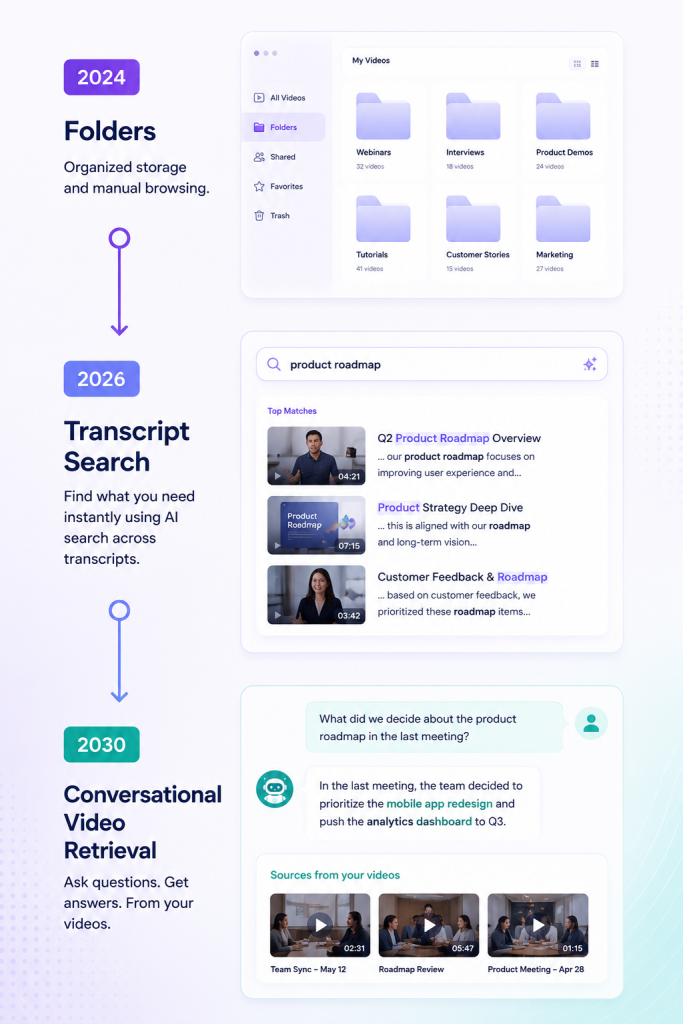
Researchers are increasingly exploring video retrieval systems and Video-RAG (Retrieval-Augmented Generation) architectures that allow users to search videos using natural language.
Instead of manually browsing folders, users may eventually ask questions such as:
- Show every webinar discussing AI automation.
- Find customer interviews mentioning onboarding challenges.
- Locate all product demos referencing integrations.
This shift turns video archives into searchable knowledge bases.
Trend #3: Long-Form Video Understanding Will Improve Content Discovery
The world's most valuable content often exists in long-form formats.
Podcasts, webinars, conferences, lectures, training programs, and interviews frequently contain hours of information.
The challenge is that understanding long videos requires maintaining context over extended periods of time.
This is one of the most active areas of research in video AI.
The Video-MME Benchmark, one of the most widely cited benchmarks evaluating long-video understanding capabilities, measures how effectively AI systems understand lengthy video content and complex temporal relationships.
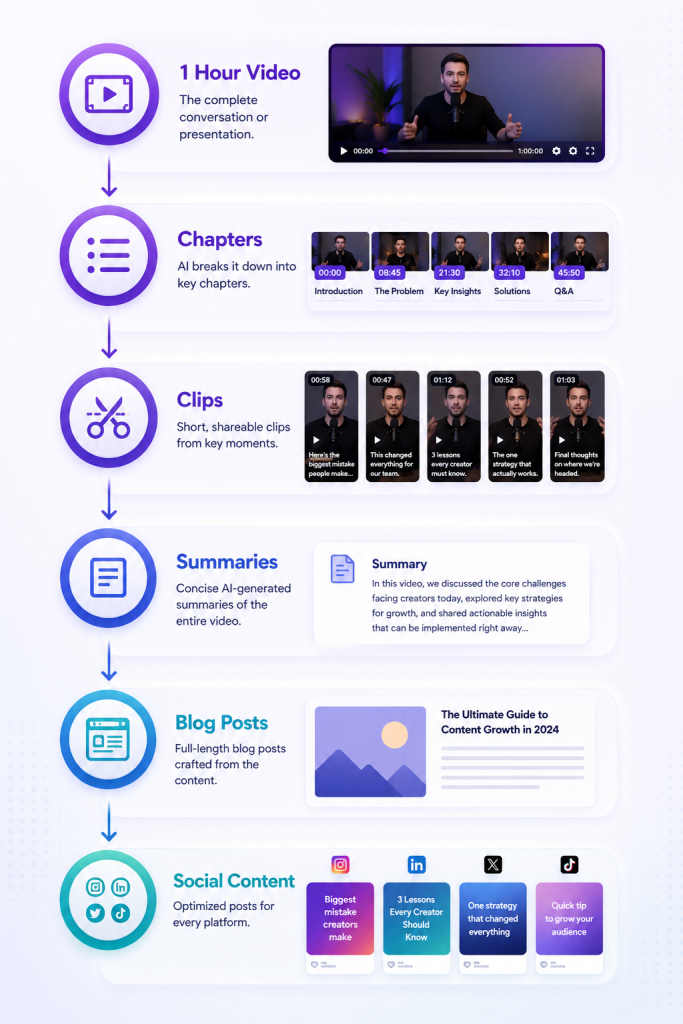
As research advances, future editing systems may automatically:
- Generate chapters
- Identify topic transitions
- Create summaries
- Extract key insights
- Surface highlight moments
Trend #4: AI Will Learn What Makes a Clip Worth Watching
Most AI editing systems today focus on identifying moments. They detect keywords, pauses, speakers, scene changes, and engagement signals to determine where clips should begin and end.
Researchers are increasingly exploring systems that go beyond detection and toward understanding. Future AI may analyze narrative structure, audience psychology, and conversational context to identify why certain moments are more compelling than others.
Instead of finding segments that merely contain keywords, AI is learning to recognize:
- Curiosity gaps.
- Storytelling arcs.
- Emotional turning points.
- Contrarian insights.
- High-retention moments.
- Strong hooks and payoffs.
Many AI video editors already help creators generate clips from long-form content. The next phase is helping creators identify not just any clip, but the clips most likely to capture attention and drive engagement.
Trend #5: One Recording Will Become an Entire Content System
The future of content creation may depend less on producing more content, and more on extracting value from every recording.
Podcasts, webinars, interviews, training sessions, and meetings often contain dozens of content opportunities. Researchers are increasingly exploring AI systems that can analyze long-form content and automatically transform it into multiple content assets.
Instead of creating one output at a time, creators may increasingly start with a single recording and allow AI to generate:
- Short-form clips.
- Chapters.
- Summaries.
- Blog content.
- Social media posts.
- Newsletters.
- Knowledge base assets.
Rather than functioning solely as editing tools, future AI systems may operate as content engines that help creators distribute ideas across multiple formats, platforms, and audiences from a single source of content.
Trend #6: Personalized Video Creation Will Scale Automatically
Content personalization has traditionally been expensive and difficult to scale. Creating separate versions of videos for different audiences often requires additional editing time, production resources, and budget.
Advances in multimodal AI and dynamic content generation are changing this. Instead of manually creating multiple edits, AI systems can analyze a video's transcript, visuals, audience intent, and platform requirements to generate tailored versions automatically.
For example, an AI system could:
- Shorten a 30-minute webinar into a 60-second TikTok clip.
- Create a professional LinkedIn version focused on business insights.
- Extract product-related segments for sales enablement.
- Generate onboarding content from training recordings.
- Repackage educational sections for internal learning programs.
In each case, the source video remains the same, but the AI changes elements such as:
- Clip selection.
- Video length.
- Titles and hooks.
- Captions.
- Calls-to-action.
- Format and aspect ratio.
- Content emphasis based on audience needs.
Trend #7: Multimodal AI Will Blur the Line Between Editing and Generation
Perhaps the most transformative trend is the convergence of video editing and video generation. Historically, editing software and content creation software served distinct functions. They modified existing footage, while generation tools created new content.
Emerging multimodal AI systems are beginning to combine these capabilities.
Research in multimodal video generation increasingly explores systems that can generate visuals, audio, speech, and motion while maintaining coherence across multiple modalities.
Future platforms may be capable of:
- Editing footage.
- Generating missing scenes.
- Creating voiceovers.
- Producing visual assets.
- Adapting content formats automatically.
This convergence could fundamentally alter video production workflows.
Instead of moving sequentially from recording to editing and publishing, creators may increasingly work with systems that generate, adapt, and optimize content dynamically.
What These Trends Mean for Content Creators
For creators, marketers, and businesses, the next generation of AI video editing offers a compelling opportunity.
With this, production cycles get faster, more content comes from fewer recordings, and video archives become searchable knowledge bases rather than unused storage.
At the same time, success will depend less on adopting individual AI features and more on building scalable content workflows.
Creators who learn how to combine AI-assisted editing, content repurposing, personalization, and workflow automation may gain a significant advantage as these technologies mature.
Where Vmaker AI Fits Into the Future of AI Video Editing
Many of the trends discussed in this article point toward the same goal: reducing manual editing work while helping creators produce more content from every recording.
While AI systems capable of understanding context, managing workflows, and personalizing content are still evolving, creators are already experiencing the first stage of this shift through AI-powered video editing tools.
Platforms such as Vmaker AI help streamline content creation with features like AI video editor, automated subtitles, long-form to short-form video conversion, and social-ready formatting. These capabilities make it easier to repurpose podcasts, webinars, interviews, and other long-form content into platform-specific videos.
As AI video editing continues to evolve, tools like Vmaker AI represent the foundation of a future where content creation, editing, and repurposing become increasingly automated and scalable.
Conclusion
The future of AI video editing is not simply about automating more editing tasks. Research suggests a broader transformation is underway, one in which AI increasingly understands, retrieves, organizes, personalizes, and even generates video content.
Over the next five years, advances in Video LLMs, multimodal AI, long-video understanding, and generative video systems may shift video editing from a production task into an intelligent content ecosystem.
For creators and businesses, the opportunity extends beyond editing faster. It lies in building workflows that transform every recording into a scalable source of content, knowledge, and audience engagement.
Research Papers & References
- Multimodal Video Generation Models with Audio: Present and Future (ResearchGate)
- Long-video understanding research (arXiv:2312.17432)
- Comprehensive Long Video Understanding Survey (GitHub)
- Video understanding research (ScienceDirect, Neurocomputing)
- Related talk (YouTube)
Frequently Asked Questions
What are Video LLMs and how do they apply to video editing?
Video Large Language Models (LLMs) are AI models that can understand videos by analyzing visuals, speech, and context. They help AI go beyond simple editing and understand what is happening in a video.
How is AI video editing different from AI video generation?
AI video editing improves existing footage by enhancing it, adding B-rolls, subtitles, transitions, music, and images from the AI editing library, while AI video generation creates new videos, visuals, or audio from scratch with a simple prompt.
Can AI understand the context and meaning of a video, not just detect scenes?
New AI models are being developed to understand stories, emotions, and context, not just detect scenes or speakers.
Will AI be able to pick which clips are worth posting?
Yes. AI is becoming better at identifying highlights, hooks, and engaging moments that are more likely to capture viewers' attention.
Does Vmaker AI do these things today?
Today, Vmaker AI helps creators generate clips, add subtitles, and repurpose videos. More advanced AI capabilities are expected to evolve over time.
How does AI personalize a single video for different platforms and audiences?
AI can adapt one video for different platforms and audiences by changing the length, captions, titles, aspect ratio, and content focus.